Sunday, March 8, 2015

Fragment from a Ladies' Book (1851)

Dawn Potter

We stand on the lofty ridge of Time!
The fashion of stiff corsets never will resume.
We are constrained to note, “The female mind
could never have devised the loom.”


[from Chestnut Ridge, a verse-history-in-progress of southwestern Pennsylvania]

**

Fashion journals such as Godey's Lady's Book had an enormous impact on American women, particular those who lived in the hinterlands. They democratized fashion: the Ingalls women, for instance, copied Godey's illustrations when they designed their new go-to-church dresses in the western territories. But magazines such as Godey's also reinforced a philosophy of womanhood: emphasizing appropriate family roles and spheres of feminine interest, and subtly (or not so subtly) dismissing woman's capacity for curiosity. At the same time, they were instrumental in promoting gradual improvements in one of the most galling of feminine fashion requirements: the corset. As period photographs make clear, corset styles changed in every decade of the nineteenth century. Whereas 1840s corsets compressed and flattened women's curves, 1890s corsets emphasized a more natural figure. A late-century woman wearing a corset could actually ride a bike or play tennis, and thus the history of middle-class leisure began to change.

For a fascinating history of the everyday dress of nineteenth-century American women, check out Joan Severa's Dressed for the Photographer: Ordinary Americans and Fashion, 1840-1900.

And never forget: "Taste and ingenuity, with a very small amount of cash, will enable a lady to appear always fashionably attired. . . . No excellence of mind or soul can be hoped from an idle woman" (Godey's, September 1845).

Saturday, March 7, 2015

Teachers and Ridicule

There's yet another Internet brouhaha about MFA degrees. A former fiction teacher at a low-residency program has published an article in which he disses a number of his students as untalented, lazy, posturing, etc., etc. The article is flippant, certainly, and I'm sure it was extraordinarily hurtful to his former students. But for me, it brought up a few questions--notably, since when is a teacher responsible only for teaching students who have the potential to be great?

Let's set aside all the many complaints (conspiracy-theory and otherwise) associated with MFA programs in writing--e.g., universities making money from students who will never get jobs, canned approaches to creative exploration, a focus on contemporary poetry at the expense of a deep knowledge of the past, a clubby exclusivity that damages the hopes of serious writers who don't have graduate degrees. Beyond these issues is the responsibility of teacher to student. Is the teacher tasked with transforming this person into James Joyce? Or is the teacher tasked with seeing the student as an individual striver, with her own knowledge and curiosity and ignorance, and helping her move more deeply into an apprenticeship with the art?

Any public school teacher can share stories about a student who, say, after an entire year of fifth grade, has finally learned to write his name, even though everyone else in the class has moved onto long division. This student's success, in that moment, reflects the enduring joy of the profession.

Perhaps one expects graduate-level work to be more dazzling. But many programs accept students who do not have strong backgrounds in creative writing, or even any background at all. Should schools call this training "master's level work"? This is a reasonable question. Meanwhile, however, the teacher must work with the students who appear in her classroom, and she owes them care and respect.

Students, especially those who are paying for a graduate degree, also have responsibility to the teacher and to the art. They need to be willing to read, for instance; and if they aren't, they shouldn't be allowed to graduate. But teachers are always going to have some students who try to get by without doing the work, others who find themselves drowning in it. At the same time teachers will have students who make vital discoveries about themselves, the world, and the work of writing--even though they may never become technically skilled enough to publish a single poem. And as human beings, these students matter a lot.

Regular readers of this blog know that I don't have an advanced degree. While I have occasionally worked as a visiting writer in graduate programs, I have done all of my own creative work outside the academy. Thus, I'm in no way spouting canned support for the status quo of the MFA. My interest is in the relationship between teacher and student. And at every level--kindergarten through postdoctoral study--the ideal should be respect as well as rigorous attention to the individual's particular needs and abilities. Ridicule has no part in that ideal.

Friday, March 6, 2015

The streets of Portsmouth may be confusing, but the arts are hopping in that town. So many people were at my reading! It was lovely and encouraging to have so many attentive and engaged listeners.

But life has now returned to its previously scheduled program--which is to say, it's twelve degrees below zero, and I'm doing laundry and editing other people's books. At the same time, however, I'm mulling over a few conversations I had in Portsmouth about the art of reading aloud. For me, it all comes down to the advice my dear, dead best friend gave me, in the days when she was thriving as an actress and I was fighting poet stage fright: "Respect your punctuation." This simple advice has improved not only my performance skills but also refined my approach to revision. If I can't say the poem effectively, then there's something wrong with the poem.

I think being a musician has also helped me. For instance, many songs slow down in the final few measures. Often the pitch drops back to the root note of the key and/or is held for an extra number of beats and/or becomes softer. In more dramatic endings, the final note may become louder or denser, as more instruments join in on related pitches or change their long smooth notes into tremolos. (For bowed-instrument players, this means repeating the same note using a succession of rapid bow changes. For other instruments, it may mean alternating rapidly between two different notes.)

Anyway, I think about these musical messages when I think about how to revise or to read a poem, and I would enjoy leading a class about performance strategies.

Wednesday, March 4, 2015

Writing about Otters


See the little sled marks, heading straight into open water at the base of the tree? I'm fairly sure they are signs of an otter slide. Do you know what this means? It means that otters are gamboling within shouting distance of my house.

According to Dorothy and Nils Hogner, in their 1942 The Animal Book,
groups of Otter[s] go tobogganing together. . . . In winter they choose a snow bank with an icy pool of water at the bottom. With their short legs turned backwards they slide down these slippery places. They toboggan for the joy it gives them to whizz downhill as children enjoy coasting. The several Otters which use one slide seem to enter into friendly rivalry in their play which has no connection with the rough play of mammals in the breeding season.
While the Hogners shamelessly humanize every mammal they discuss in this book, their prose also displays a midcentury charm--a comfortable storytelling urge that I've noted in many other works of nonfiction published during this era. The descriptions in Olaus J. Murie's 1954 Animal Tracks (later reprinted as a Peterson Field Guide), though more exact, are almost as cozy as the Hogners':
One wintry day in southern Hudson Bay territory I was snowshoeing up a small stream when I spied a movement on the snowy streambank ahead. I realized that it was an otter, and the next moment it slid down the bank. Another one appeared, clambered up the bank, and slid down. A third appeared from a hole in the ice, and for several minutes I watched these frolicsome animals, climbing, sliding, climbing, sliding, over and over again--until they all disappeared under the ice. Their playtime was over, and they went on their way beneath the ice, as they so often do.
Compare those styles with the precision of Thoreau's December 6, 1856, journal entry:
Just this side of Bittern Cliff, I see a very remarkable track of an otter, made undoubtedly December 3d, when this snow ice was mere slosh. It had come up through a hole (now black ice) by the stem of a button-bush, and, apparently, pushed its way through the slosh, as through snow on land, leaving a track of eight inches wide, more or less, with the now frozen snow shoved up two inches high on each side, i.e., two inches above the general level. Where the ice was firmer are seen only the tracks of its feet. It had crossed the open middle (now thin black ice) and continued its singular trail to the opposite shore, as if a narrow sled had been drawn bottom upwards.
Thoreau goes on to describe the consistency of otter scat ("a mass of fishes' scales and bones") as well as variations in the animals' movements: "Sometimes one had trailed his tail, apparently edge-wise, a mark like the tail of a deer mouse."

To my surprise, my edition of James Frazer's The Golden Bough (1922) has nothing to say about the otter as a mythological force. All that human-like play should be ripe fodder for magical significance. But my abridged version of the journals of Lewis and Clark does contain a single reference to the animal, in Lewis's August 20, 1805, entry:
The tippet of the Snake Indians is the most eligant peice of Indian dress I ever saw, the neck or collar of this is formed with a strip of dressed Otter skin with the fur, it is about four or five inches wide and cut out of the back of the skin the nose and eyes forming one extremity and the tail the other. begining a little behind the ear of the animal at one edge of this collar and proceeding towards the tail, they attach from one to two hundred and fifty little roles of Ermin skin . . . covers the solders and body nearly to the waist and has the appearance of a short cloak and is really handsome. these they esteem very highly, and give or dispose of only on important occasions.
In his own journal entry, written fifty years after Lewis's, Thoreau notes the long history of otter hunting in North America ("the Pilgrims sent home many otter skins in the first vessels that returned [to England]") yet also remarks that "it is surprising that our hunters know no more about them." It seems that only Thoreau and his companions were hunting the otters of Concord, Massachusetts. "Our eyes go searching along the stems for what is most vivacious and characteristic, the concentrated summer gone into winter quarters. For we are hunters pursuing the summer on snow-shoes and skates, all winter long. There is really but one season in our hearts."

Tuesday, March 3, 2015

I was so surprised and happy yesterday to discover Maureen Doallas's review of my anthology, A Poet's Sourcebook. Reviews make me nervous, always--not only because I fear that someone will hate my book but also because I can't help perceiving glitches between what I did in the book and how someone else absorbed it. My Milton memoir has been particularly prone to such readings. This is normal, and is often even enlightening, but I worry anyway ("I'm so stupid, why didn't I see that before, people will think I'm an idiot," and other such pointless flagellations).

But Maureen seemed to take in the anthology in a way that paralleled my intentions. This may be easier in an edited work as opposed to an entirely original construction; but as I discovered while I was working on A Poet's Sourcebook, compiling an anthology is subjective. There are no obvious selections to include. For instance, is Shelley's "Defense of Poetry" necessary and exciting or the tedious emotings of Nineteenth-Century Important White Guy? I fall into the "necessary and exciting" category, but plenty of other people don't. All the syntheses that I perceive between Shelley's treatise and the writings of subsequent poets and critics (John Berger, Audre Lorde, etc., etc.) may not register with other imaginary editors.

In any case, I'm grateful to Maureen for sharing my fascination with "the kinds of serendipitous discoveries that accompany re-familiarizing oneself with the texts of Plato, Aristotle, and Ovid; re-engaging with the likes of Shakespeare, Bradstreet, Milton, and Blake; re-considering Shelley and Keats, Bronte and Whitman, Dickinson and Rilke, Woolf and Pound; and recalling the depth of inspiration and breadth of influence of Rich and Levertov, Snyder and Milosz." I have spent a lifetime fluttering here and there among my books, and one of the gifts of this project was the way in which it forced me to annotate, and thus justify, my desultory reading patterns.

Monday, March 2, 2015

Last night, a dust of snow. This morning, a clean opaque dawn and 15 degrees above zero.

Small birds barrage the empty feeder. I feel the pressure of words--unformed, unthought--behind my skull.

I have been reading a small Harold Pinter play, "Night," which opens like this:
Man. I'm talking about that time by the river.
Woman. What time?
Man. The first time. On the bridge. Starting on the bridge. 
        Pause. 
Woman. I don't remember.
The pressure of words behind my skull resembles their interchange.

Sunday, March 1, 2015

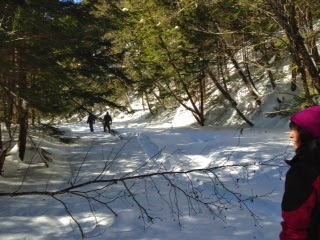
The radio guy announced, "Saturday will be a great day for winter sports!" So despite the cold, we decided to go on a long snowshoe trek with our friends Sue and Dave.

Below you see can the stream bed, with Tom and Dave far ahead of Sue and me. We were slow because we kept looking at animal tracks. I know very little about tracking but Sue knows quite a bit, and I love to be instructed in such things.


Here is one of many crevasses on the stream. Despite the subzero temperatures, the water continues to bubble and run. 


The sky was a miraculous blue. But the birds were silent.


The stream opens into this bog. The small scrubby trees are alders, and on a few of them the buds are beginning to swell. Think of this as a photograph of spring.


According to Sue, these are mink tracks. After she showed me the tracks, she told a story from her childhood: one day the kids came to the school and found an ermine inside.


See this print that looks like a lobster's snow angel? This is the track of the snowshoe hare.


Here's another crevasse, this time on the bog. Because the water is quieter than the stream's, it has formed these ice flowers.